The short version
A practical, honest guide for first-time Africa travelers in 2026 — choosing a region, visas, safety, budget, packing, and why a guide changes everything.
What do I need to know before traveling to Africa for the first time?
Africa is 54 countries, not one destination, so the biggest first-timer mistake is planning as if it were a single trip. Choose one region and go deep, arrange your visa in advance, and consider a guided first trip for the local knowledge and logistics it removes.
Safety is regional and specific rather than one continent-wide risk level, and most countries require a visa arranged before you travel, not on arrival. This guide walks through the real decisions a first-time Africa traveler needs to make in 2026.
Quick Facts
| Biggest first-timer mistake | Treating "Africa" as one destination instead of picking a region |
| Visa reality | Most countries require pre-arranged e-Visas now, not visa-on-arrival |
| Best first trip length | 5–10 days focused on one country or region |
| Safety approach | Regional, not continent-wide — research the specific areas you'll visit |
| Is a guide worth it for a first trip? | Yes, for logistics, safety context, and cultural access alone |
How do you choose a region for your first trip?
Africa spans more area than the US, China, India, and most of Europe combined — East Africa's safari circuit, Southern Africa's wildlife and wine country, North Africa's ancient history, and West Africa's cultural heritage and diaspora tourism are genuinely different trips with different infrastructure, climates, and costs. Pick one region for a first trip rather than trying to sample the continent broadly; you'll get a far better experience going deep into Ghana and Nigeria, or Kenya and Tanzania, than skimming the surface of four countries across three regions. See our Top 10 Countries to Visit in Africa in 2026 for a starting shortlist by region.
Visas — what's actually changed
The visa-on-arrival system many travelers still expect from older guidebooks and secondhand advice has largely disappeared across the continent's most-visited countries. Nigeria, for example, replaced visa-on-arrival entirely with a mandatory pre-departure e-Visa system in 2025 — see our Nigeria e-Visa Guide 2026 for the specifics. The pattern holds broadly across the continent: research and apply for your visa online, weeks ahead of travel, rather than assuming you can sort it out at the airport. Requirements vary meaningfully by nationality and country, so check the specific rules for your passport and destination rather than relying on general assumptions.
Safety: the regional reality
"Is Africa safe?" isn't a coherent question — Africa is 54 countries with wildly different security situations, and even within a single country, risk is regional, not national. Nigeria is the clearest example: Lagos, Abuja, Abeokuta, and Calabar — the areas most guided tours actually operate in — are broadly safe for prepared visitors, while the northeast and northwest carry real, government-flagged risk. That regional pattern repeats across the continent. The practical approach: research the specific cities and regions your trip actually covers, not a single country-wide or continent-wide headline, and lean on a local guide's current knowledge over general internet sentiment. See our region-by-region Nigeria safety breakdown as a model for how to think about this anywhere.
How much should you budget for your first trip?
Costs vary enormously by region and travel style. A guided one-week trip in West Africa typically runs $1,000–$2,500 per person excluding flights; East African safari trips generally run higher given park fees and lodge pricing specific to wildlife tourism. International flights add $700–$1,500+ depending on your departure city and destination. Build in a buffer for December specifically if your dates land there — West Africa's Detty December season and East Africa's own peak safari season both carry real price premiums. See our West Africa trip cost guide for a fuller breakdown.
What vaccinations and health precautions do you need?
Yellow fever vaccination is mandatory for entry to many African countries, including Nigeria and Ghana, and is often checked at the border — get vaccinated well ahead of travel, since it typically needs to be administered at least 10 days before entry to be valid. Malaria prophylaxis is worth discussing with a travel clinic depending on your specific itinerary and season. Standard travel vaccinations (hepatitis A/B, typhoid) are commonly recommended regardless of destination — consult a travel medicine provider rather than general internet advice for your specific health situation.
What should you pack for Africa?
Lightweight, breathable clothing for tropical West Africa; layers for cooler mornings if your itinerary includes higher-elevation or northern regions with a pronounced dry-season temperature drop. Comfortable closed-toe shoes with real grip — many worthwhile stops (Olumo Rock, Lekki Conservation Centre's canopy walkway, Kakum National Park in Ghana) involve uneven terrain. A universal power adapter, a portable charger, and a copy of your visa/eTAL and yellow fever certificate kept accessible, not buried in checked luggage.
Should you go independent or guided?
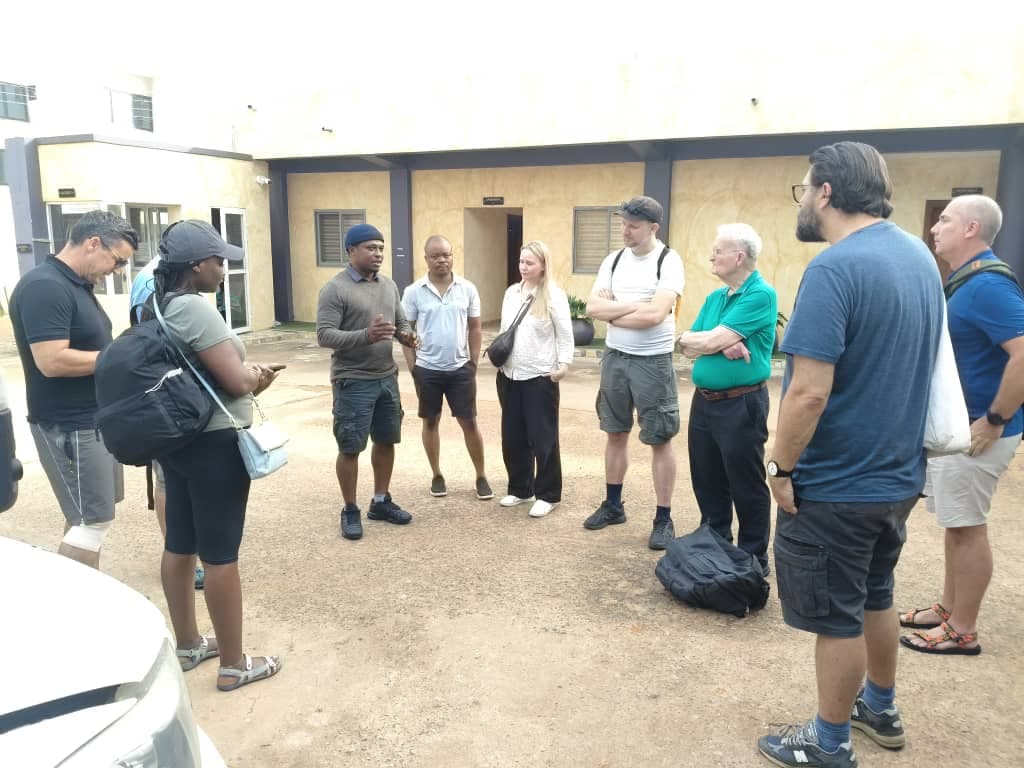
For a first Africa trip specifically, guided travel is worth serious consideration even if you're an experienced independent traveler elsewhere. The value isn't just convenience — it's regional safety context you can't fully replicate from research alone, vetted transport in cities where navigating independently is genuinely harder than in most first-world destinations, and cultural access (specific historical context, community connections) that a good local guide provides and a guidebook can't. Our own guide to choosing a trustworthy tour operator covers what separates a good guide from a risky one, wherever in Africa you're going.
Cultural etiquette basics
Greetings matter more formally across much of Africa than many Western travelers expect — take the extra moment for a proper greeting before getting to business, whether that's at a market stall or a formal meeting. Dress modestly at religious sites and in more conservative regions specifically, even if beach and nightlife areas are more relaxed. Ask before photographing people directly, and expect bargaining at markets to be a normal, even expected, part of the transaction rather than an imposition.
Why West Africa is an underrated first choice
East Africa's safari circuit gets most of the "first trip to Africa" marketing, but West Africa offers a genuinely different, equally valid entry point: deep cultural and historical heritage (Ghana's Cape Coast and Elmina, Nigeria's Badagry slave route), some of the continent's most significant living festival culture (Osun-Osogbo, Calabar Carnival, Detty December), and generally lower costs than East African safari tourism, without sacrificing depth. If your interest leans toward culture, history, food, and music over wildlife specifically, West Africa deserves to be your first stop, not your second.
Common myths worth retiring before you go
"Africa is one place." It's 54 countries with different languages, currencies, climates, and cultures — closer to comparing "Europe" as a single destination than a single country.
"It's all safari." Wildlife safari is one specific kind of African trip, concentrated mainly in East and Southern Africa. West Africa's draw is cultural heritage, history, music, and food — a genuinely different kind of trip, not a lesser one.
"You need visa-on-arrival flexibility to plan easily." The opposite is now true in most popular destinations — pre-arranged e-Visas are the standard, and showing up without one increasingly means not boarding your flight at all.
"It's not worth going without a big group tour." A well-chosen local guide with a small group, or even a private guide, generally gives a more responsive, personal experience than a large fixed-departure group tour — worth weighing against the assumption that bigger automatically means safer or better value.
What should you read next?
Frequently asked questions
What should I know before my first trip to Africa?
That Africa is 54 countries, not one destination — choose a specific region rather than trying to see the continent broadly, research visa requirements early (most now require pre-arranged e-Visas), and treat safety as regional rather than continent-wide.
Is it safe to travel to Africa for the first time?
Safety varies enormously by specific country and region — it's not a single continent-wide answer. Research the specific areas your trip covers, and consider a guided trip for a first visit, since local, current knowledge meaningfully changes the risk picture.
Do I need a visa to travel to Africa?
Almost always yes, and increasingly through pre-arranged e-Visa systems rather than visa-on-arrival — requirements vary by nationality and destination country, so check the specific rules well ahead of travel.
Should my first trip to Africa be guided or independent?
Guided is genuinely worth considering for a first trip, even for experienced independent travelers — the regional safety context, vetted transport, and cultural access a good local guide provides are hard to replicate through research alone.
Is West Africa a good first trip to Africa?
Yes, particularly if cultural heritage, history, food, and music interest you more than wildlife safari specifically — Ghana and Nigeria offer deep, well-supported first-time tourism infrastructure at generally lower cost than East African safari trips.
How much does a first trip to Africa cost?
A guided one-week West Africa trip typically runs $1,000–$2,500 per person excluding flights; East African safari trips generally run higher given park fees and lodge pricing. Add $700–$1,500+ for international flights depending on origin.