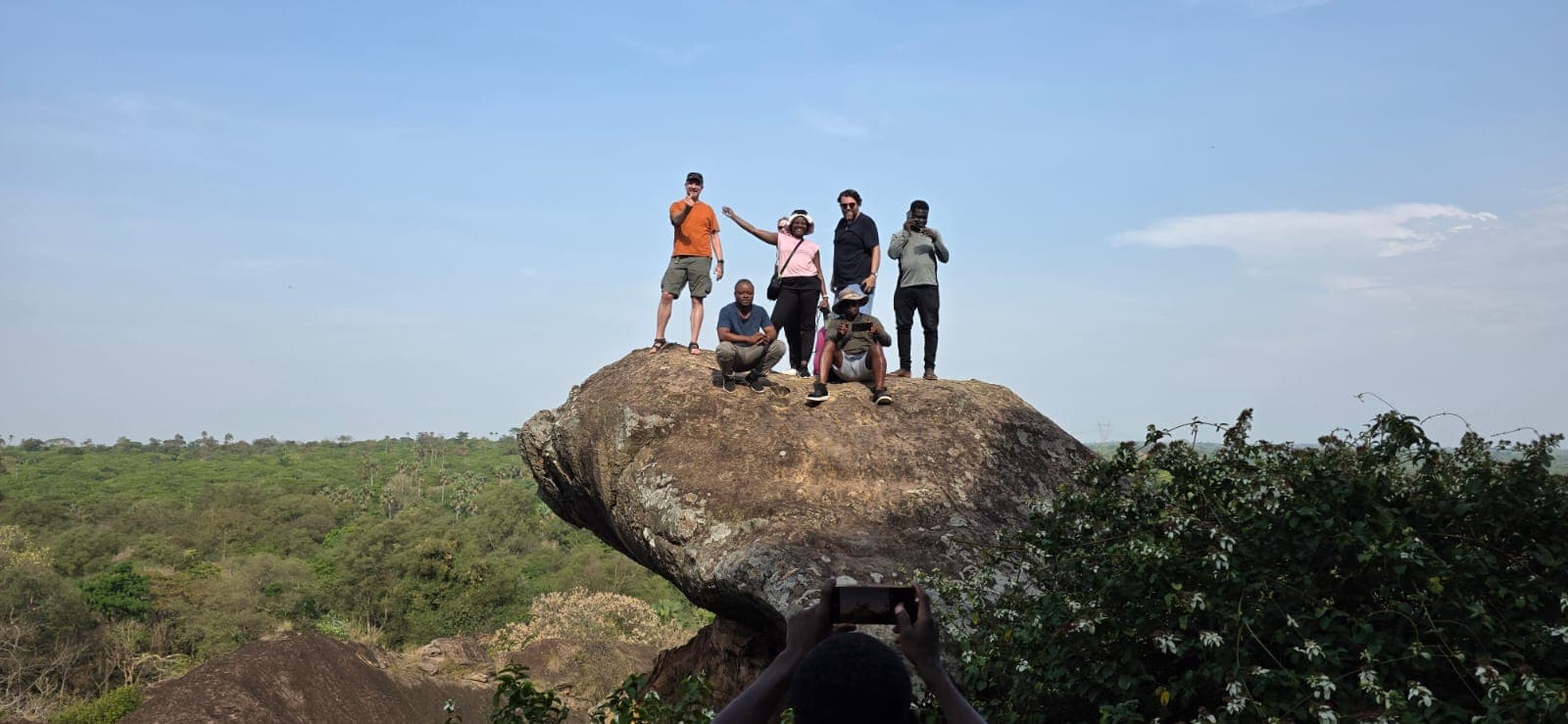
The short version
Climbing Olumo Rock in Abeokuta in 2026: the Egba history behind it, what the climb involves, costs and current visiting info.
What is Olumo Rock, and why does it matter?
Olumo Rock is a 137-meter granite outcrop in Abeokuta, Ogun State, and it is the reason the city exists. "Abeokuta" literally means "under the rock," and the city was founded around it in 1830 when the Egba people, fleeing the collapse of the Oyo Empire and slave-raiding forces, took refuge in its caves and crevices on the guidance of the Ifa oracle.
This is a single-attraction deep dive — for the rest of Abeokuta (Ake Palace, Itoku Adire market, and the city's broader history), see our full Abeokuta guide, or our Abeokuta & Olumo Rock: Complete 2026 Guide for both in one place with current costs and a sample itinerary.
The history: refuge, not just rock
Olumo Rock was reportedly discovered around 1830 by a hunter named Adagba, and quickly became the site where the Egba — displaced by the collapse of the Oyo Empire and under pressure from slave-raiding campaigns — established their new settlement. The rock's caves and elevated terrain gave the Egba a genuine defensive advantage: raised vantage points to monitor approaching threats, natural shelter, and defensible high ground during the intertribal conflicts of the early-to-mid 19th century, including documented clashes with Dahomey forces in the 1840s and 1850s.
This is worth sitting with for a moment rather than rushing past: the rock isn't a photogenic backdrop with a footnote of history attached. It's closer to the reason a whole people survived a specific, violent period, and the reason a city of over a million people exists on this spot today. Local guides at the site can point out specific caves and vantage points used during that period, which is part of what separates a guided visit from simply walking up and taking photos.
Who was Sodeke?
Sodeke is the Egba military leader most closely credited with organizing the various displaced Egba townships — scattered after the fall of Oyo and the destruction of their original settlements — into the unified community that became Abeokuta, with Olumo Rock as its defensive anchor. Rather than a single town relocating, Abeokuta's founding was closer to a federation: multiple Egba sub-groups, each with their own leadership, consolidating around the rock for mutual protection under Sodeke's coordination in the late 1820s and early 1830s. That federated structure is still reflected today in Abeokuta's traditional governance, where several quarters retain distinct historical identities under the overarching leadership of the Alake, the paramount ruler of the Egba.
Understanding this changes how you read the rock itself: it wasn't a single group's hideout so much as the physical anchor point that let several separate, vulnerable communities become one defensible city.
What is the Olumo Rock climb like?
You have two ways up: the original hand-carved rock steps, worn smooth by generations of use, or a modern lift installed in 2006 during Governor Gbenga Daniel's administration for visitors who can't or don't want to climb. Most visitors — especially first-timers — do at least part of the ascent on foot even if they take the lift partway, since the steps and narrow passages between boulders are part of the experience.
For a reasonably fit visitor, the climb itself takes around 20 minutes, including stops to catch your breath and take in the views as you go. It's not a technical climb — no ropes or equipment — but expect some narrow, uneven sections between the boulders, and wear shoes with real grip rather than sandals. Along the way, guides typically point out specific caves used historically for shelter and food storage during the Egba's 19th-century conflicts.
The route winds between boulders large enough that you lose sight of the surrounding city for stretches at a time, which is part of what makes the eventual view from the top land as a genuine payoff rather than a gradual reveal. Some sections narrow enough that you'll turn sideways to pass through, a reminder of how naturally defensible this terrain was long before anyone built stairs into it. Families with young children and older visitors more commonly use the lift for some or all of the ascent, while the steps remain the more popular choice for visitors specifically wanting the full historical experience.
What you'll see from the top
The payoff is a genuine panoramic view over Abeokuta — a rare vantage point in a city where most of the built environment is at ground level, so the elevation change feels more dramatic than the 137-meter height might suggest on paper. You can pick out the Ogun River winding through the city, the rooftops of the old town spreading out below, and on a clear day, a sense of just how far the city extends from what was once a single defensive position. Morning visits tend to have the clearest light and cooler temperatures for the climb; by midday, both the heat and the haze increase.
At the summit, you'll also find a small shrine area and space where local guides sometimes point out ceremonial or traditional significance still attached to the rock today — it isn't purely a historical relic; it retains meaning for the Egba community in the present, not just in the story of how the city began.
Common misconceptions
"It's just a big rock with a view." The height and view are real draws, but treating Olumo Rock as a generic scenic overlook misses what makes it significant — it's the specific reason a major Nigerian city exists where it does, not an arbitrary high point that happened to get developed for tourism.
"You need serious hiking gear." You don't. It's a well-worn, well-trafficked route with a lift option for anyone who doesn't want to climb — closer to a moderately strenuous stair climb than a hike.
"It's only worth visiting for the history, not as an experience." The climb itself, moving through narrow passages between genuinely massive boulders with the city gradually opening up below you, is a good experience in its own right, independent of the historical context — though the history is what makes it memorable rather than just scenic.
What should you know before you visit Olumo Rock?
| Detail | Information |
|---|---|
| Location | Ikija, Abeokuta, Ogun State, Nigeria |
| Height | 137 meters |
| Climb time | ~20 minutes on foot (fit visitor) |
| Ascent options | Hand-carved rock steps, or lift (installed 2006) |
| Best time to visit | Morning — cooler, clearer views |
| Entry fee | Roughly ₦2,500 (~$1.70) adults via stairs, up to ₦3,500 (~$2.40) via elevator; lower child rate |
| Guide recommended? | Yes — for historical context on the caves and vantage points |
(Figures reflect the most recent publicly reported price update as of this writing — management adjusts pricing periodically, so confirm the current rate on arrival or with your guide before finalizing a budget.)
Olumo Rock is typically visited as a half-day stop, easily combined with other Abeokuta sites (Ake Palace, Itoku Adire market) or done as a day trip from Lagos, roughly an hour to 90 minutes away depending on traffic.
What to bring: closed-toe shoes with real grip (not sandals or heels), water, and a hat or sunscreen if you're climbing midday rather than in the cooler morning hours. There's minimal shade on parts of the ascent.
Photography tips: the best wide shots of Abeokuta are from the upper platforms near the summit, ideally in the first couple of hours after sunrise when the light is softer and the haze that builds up over the day hasn't set in yet. If you're bringing a proper camera rather than a phone, budget extra time — the narrow passages between boulders aren't ideal for maneuvering camera bags, so plan to pause rather than shoot while moving.
Food and rest nearby: there are small vendors and rest areas at the base of the rock selling drinks and snacks, useful for rehydrating after the climb before moving on to the rest of an Abeokuta itinerary.
What should you read next?
Part of a day trip from Lagos
Olumo Rock pairs naturally with the rest of Abeokuta — see our full Abeokuta city guide for Ake Palace, Itoku Adire market, and how to structure the day. For Yoruba heritage further afield, our Osun-Osogbo Festival Tour covers the wider cultural region. Get a custom quote for a Lagos-area day trip built around Olumo Rock specifically.
---
Frequently asked questions
How long does it take to climb Olumo Rock?
Around 20 minutes for a reasonably fit visitor climbing at a comfortable pace with photo stops, plus additional time at the top to take in the views. Budget 45–60 minutes total for the climb and summit if you're not in a rush.
Is Olumo Rock difficult to climb?
No technical skill or equipment is needed — it's a series of rock steps and narrow passages between boulders, not a rope climb. It does involve some uneven footing, so reasonable fitness and proper footwear help. A lift is available for visitors who prefer not to climb.
How much does it cost to visit?
Recent reported pricing runs around ₦2,500 (roughly $1.70) for adults using the stairs and up to ₦3,500 (roughly $2.40) via the elevator, with a lower child rate — genuinely inexpensive, though management adjusts pricing periodically, so confirm the rate on arrival or check with a local guide before your visit.
Is Olumo Rock worth visiting?
Yes — it's one of the more historically significant sites in southwestern Nigeria specifically because of what it represents (a 19th-century refuge that became a city), not just for the view, which is also genuinely good.
Can I visit Olumo Rock without a guide?
You can, but a guide adds real value here — pointing out the specific caves and vantage points tied to the Egba's history, which aren't otherwise labeled or explained on-site.
Is the lift or the stairs better?
Most visitors do at least part of the climb on the original steps for the experience, and use the lift if they're short on time, traveling with someone who can't manage the stairs, or simply want the option down after climbing up. Neither is objectively "better" — they serve different needs.
How far is Olumo Rock from Lagos?
Roughly 60–90 minutes by road depending on traffic and your starting point in Lagos, making it a genuinely feasible half-day or full-day trip rather than requiring an overnight stay.
What should I wear to climb Olumo Rock?
Closed-toe shoes with good grip, comfortable clothing you can move freely in, and sun protection if you're visiting outside the early morning window. Avoid sandals, flip-flops, or heels — the rock steps and boulder passages require secure footing.
Is Olumo Rock suitable for children or older visitors?
Yes, with the lift as an option for anyone who shouldn't attempt the full climb on foot. Families commonly visit together, splitting between the stairs and the lift depending on individual fitness and preference.