The short version
Everything to know before visiting Abeokuta and climbing Olumo Rock in 2026 — costs, timing, getting there from Lagos, and what's genuinely worth it.
What should I know before visiting Abeokuta and Olumo Rock?
Abeokuta is the historic Egba capital, 60 to 90 minutes from Lagos and built around Olumo Rock, a 137-meter granite outcrop. A day trip covering the rock, the Itoku Adire tie-dye market and Ake Palace is easy from Lagos and one of southwestern Nigeria's most historically dense short trips.
The rock sheltered the Egba people during the 19th-century collapse of the Oyo Empire, and the city's name literally means "under the rock." This guide brings together our earlier Abeokuta and Olumo Rock coverage into one current, complete reference.
Quick Facts
| Distance from Lagos | 60–90 minutes by road, depending on traffic |
| Olumo Rock height | 137 meters |
| Climb time | ~20 minutes on foot (fit visitor), plus a lift option |
| Best time to visit | Morning — cooler, clearer views before midday haze |
| City founded | Around 1830, by the Egba people under Sodeke's leadership |
| Minimum time needed | Half a day for Olumo Rock alone; a full day for Abeokuta overall |
Why this guide replaces our two earlier posts
We've previously covered Abeokuta and Olumo Rock as two separate articles — a full city guide and a single-attraction deep dive on the climb itself. Both are still live and worth reading for their extra depth, but this guide consolidates the practical planning information (cost, timing, logistics, what's genuinely worth it) that a first-time visitor actually needs into one current reference, rather than requiring you to piece it together across two pages. If you want the fuller narrative history and Sodeke's specific role in Abeokuta's founding, our original Abeokuta guide and Olumo Rock deep dive go further into that story.
Why Abeokuta exists where it does
Olumo Rock isn't a scenic backdrop with a historical footnote attached — it's the specific reason a city of over a million people exists at this location. Around 1830, the Egba people, displaced by the collapse of the Oyo Empire and under pressure from slave-raiding campaigns, took refuge in the rock's caves and elevated terrain under the leadership of Sodeke, a military leader who organized scattered Egba townships into a unified, defensible community. Rather than one group relocating, Abeokuta's founding was closer to a federation — multiple Egba sub-groups consolidating around the rock for mutual protection, a structure still reflected today in the city's traditional governance under the Alake, the paramount Egba ruler. Understanding this before you visit changes what the climb means: you're not touring a viewpoint, you're standing in the specific place a threatened people turned into a surviving city.
What is it like to climb Olumo Rock?
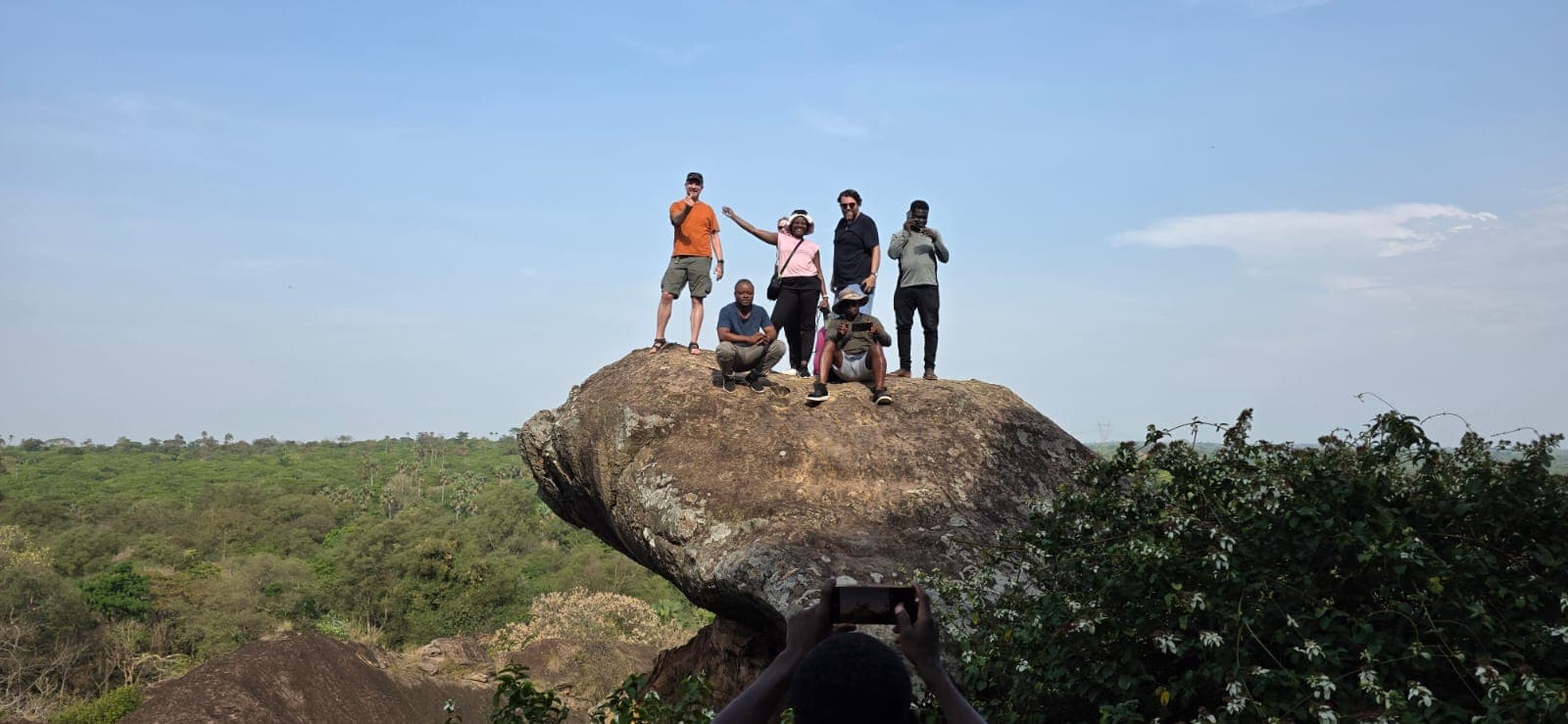
You have two ways up: the original hand-carved rock steps, worn smooth by generations of use, or a lift installed in 2006 for visitors who can't or don't want to climb. Most first-timers do at least part of the ascent on foot even if they take the lift partway — the narrow passages between boulders are genuinely part of the experience, not just a means to the top. For a reasonably fit visitor, the climb itself takes around 20 minutes including photo stops, with local guides pointing out specific caves used historically for shelter during the Egba's 19th-century conflicts, including documented clashes with Dahomey forces in the 1840s–50s.
The payoff at the top is a genuine panoramic view over Abeokuta — the Ogun River winding through the city, the old town's rooftops spread out below, and on a clear day, a real sense of how far the city now extends from what was once a single defensive position. Morning visits have the clearest light and cooler climbing conditions; by midday, heat and haze both increase. Wear closed-toe shoes with real grip, not sandals — some sections narrow enough that you'll turn sideways to pass between boulders.
Beyond the rock: the rest of Abeokuta
Olumo Rock is the headline, but a full Abeokuta day benefits from two more stops. Itoku Adire Market is Abeokuta's tie-dye textile market and genuinely worth visiting for the craft itself — Adire is a resist-dyeing technique with deep roots in Yoruba textile tradition, and watching or buying directly from the market gives more context than any souvenir shop version. Ake Palace, seat of the Alake, offers a direct look at Abeokuta's traditional governance structure and the federated-township history that shaped the city's founding. Together with Olumo Rock, these three stops cover Abeokuta's defining threads — natural landmark, living craft tradition, and traditional political history — in a single, manageable day.
How do you get to Abeokuta from Lagos?
Abeokuta is roughly 60–90 minutes from Lagos by road, depending on traffic and your starting point within Lagos — genuinely feasible as a half-day or full-day trip without an overnight stay. Independent travel by road is possible, but a guided day trip removes the friction of navigating Lagos traffic out and back, plus getting between Olumo Rock, Itoku Adire, and Ake Palace efficiently within a single day.
How much does it cost to visit Abeokuta and Olumo Rock?
Olumo Rock's entry fee has been updated periodically, and reported recent pricing sits around ₦2,500 (roughly $1.70) for adults using the stairs and ₦2,500–₦3,500 (roughly $1.70–$2.40) for the elevator, with a lower child rate — genuinely inexpensive in dollar terms, though management updates pricing from time to time, so confirm the current rate on arrival or through your guide rather than budgeting off an old figure. Beyond entry, a guided day trip from Lagos covering all three stops (transport, guide, entry fees) typically falls within the lower end of a single-day guided-tour budget compared to multi-day Nigeria trips — see our full Nigeria cost breakdown for how a day trip like this compares to a longer itinerary.
What's genuinely worth it vs. skippable
Olumo Rock and Itoku Adire Market are both worth prioritizing if your time is limited — the rock for its historical weight and genuine climb, the market for an authentic craft experience you won't find replicated in Lagos. Ake Palace is worth including if you have a full day rather than a rushed half-day, since its value is more in the context and explanation a guide provides than in standalone visual impact. If you're genuinely pressed for time, Olumo Rock alone still justifies the trip from Lagos — it's the single most historically significant stop, and the one most visitors specifically travel to Abeokuta for in the first place.
When is the best time to visit Abeokuta?
Morning is the clear best window for Olumo Rock specifically — cooler temperatures for the climb and clearer visibility from the summit before midday haze builds up. For Abeokuta broadly, the dry season (November–March) offers the most comfortable overall conditions, though the city is a viable day trip year-round given how short the visit is relative to a multi-day itinerary. If you're timing a Yoruba-heritage-focused trip more broadly, consider pairing Abeokuta with the Osun-Osogbo Festival at the UNESCO-listed sacred grove, held in late July into early August — see our Osun-Osogbo Festival Tour for how the two combine.
How Abeokuta compares to Nigeria's other Yoruba heritage stops
Abeokuta is often the first Yoruba heritage stop travelers add to a Lagos-based trip, precisely because of the short travel time — but it's worth knowing how it fits alongside the region's other major sites. The Osun-Osogbo Sacred Grove, a UNESCO World Heritage site further into Osun State, offers a living religious site along the Osun River, most vivid during its late-July-to-August festival — a different kind of Yoruba heritage experience than Abeokuta's history-and-craft focus, more about an active spiritual practice than a historical narrative. Together, Abeokuta and Osun-Osogbo make a genuinely strong combined Yoruba-heritage itinerary if you have more than a single day, which is exactly what our Osun-Osogbo Festival Tour is built around. If you only have one day, Abeokuta's shorter distance from Lagos makes it the more practical standalone choice.
Sample day-trip itinerary
Morning: Depart Lagos early, arrive Abeokuta, climb Olumo Rock while conditions are coolest and clearest.
Midday: Itoku Adire Market — browse, watch the dyeing process, buy directly from makers.
Afternoon: Ake Palace, then depart back to Lagos ahead of evening traffic.
This structure fits comfortably inside a single day, though an overnight stay works if you'd rather split the pace or extend toward Osun-Osogbo the following day.
What should you read next?
Frequently asked questions
How long does it take to climb Olumo Rock?
Around 20 minutes for a reasonably fit visitor at a comfortable pace with photo stops, plus time at the summit. Budget 45–60 minutes total for the climb and viewing.
Is Olumo Rock difficult to climb?
No technical skill or equipment is needed — it's rock steps and narrow passages between boulders, not a rope climb. A lift is available for visitors who prefer not to climb.
How far is Abeokuta from Lagos?
Roughly 60–90 minutes by road depending on traffic, making it a genuinely feasible half-day or full-day trip without needing to stay overnight.
What else is there to do in Abeokuta besides Olumo Rock?
Itoku Adire Market (tie-dye textiles) and Ake Palace (seat of the Alake, Abeokuta's traditional ruler) both pair naturally with Olumo Rock in a single day trip.
Do I need a guide to visit Olumo Rock?
You don't strictly need one, but a guide adds real value — pointing out the specific caves and vantage points tied to Egba history that aren't otherwise labeled on-site.
Is Abeokuta worth visiting if I only have one day in the region?
Yes — Olumo Rock alone justifies a day trip from Lagos given its historical significance, and adding Itoku Adire Market rounds out the day without requiring an overnight stay.
What's the best time of day to climb Olumo Rock?
Morning — cooler temperatures make the climb more comfortable, and visibility from the summit is clearest before midday heat and haze build up.