The short version
Visiting Ganvié, Benin's floating village on Lake Nokoué, in 2026: history, getting there, real costs, etiquette and an honest DIY vs guided comparison.
What is Ganvié, and why is it called the "Venice of Africa"?
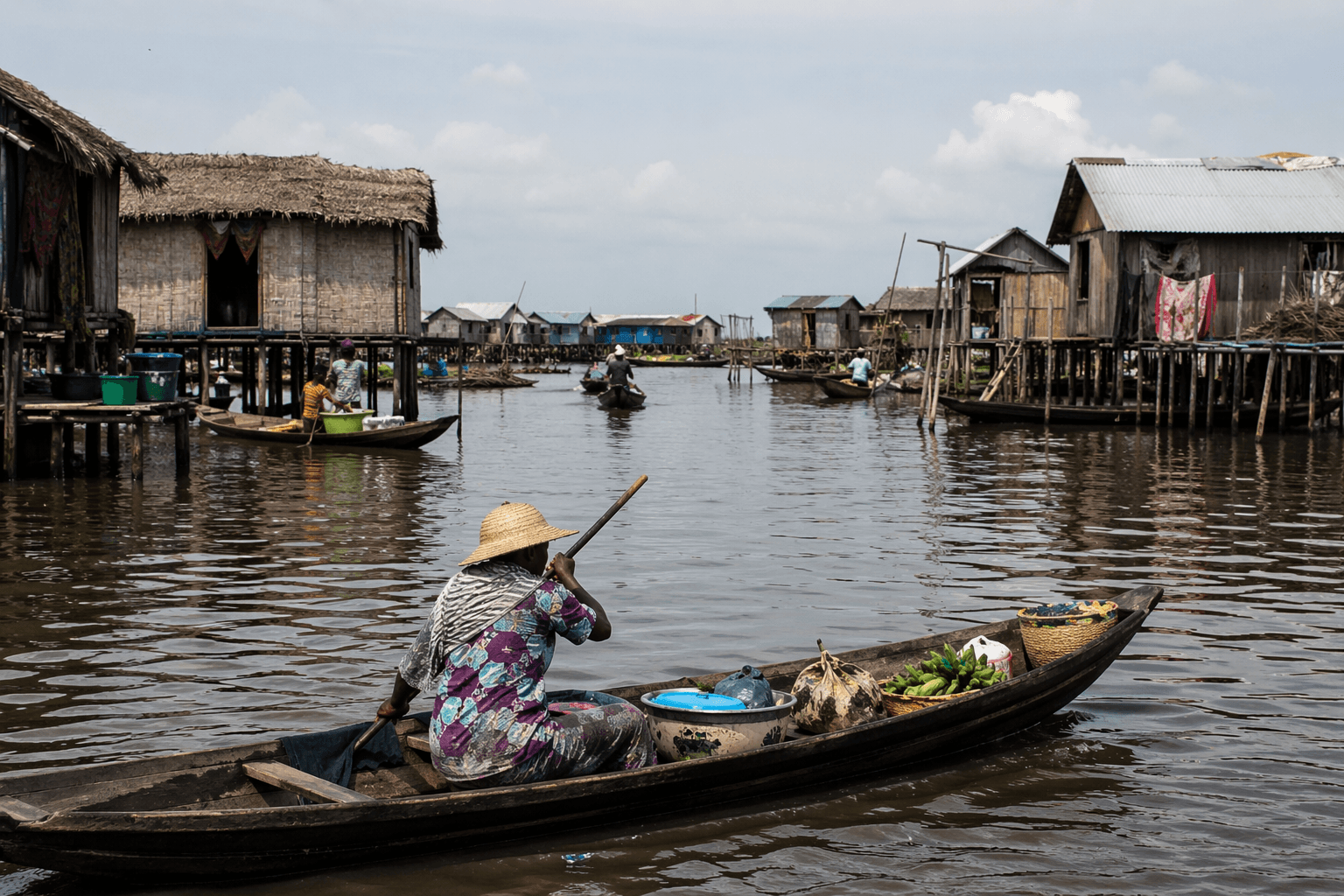
Ganvié is a village of an estimated 20,000–30,000 people built entirely on stilts over Lake Nokoué in southern Benin, reachable only by boat — hence the "Venice of Africa" comparison you'll see everywhere, including in this article's title. Unlike Venice, Ganvié wasn't built for trade or prestige; it was built for survival. The Tofinu people constructed it on the water specifically because the Kingdom of Dahomey's slave raiders, bound by their own religious taboo against entering the lake, wouldn't follow them there.
That history is the whole reason Ganvié exists, and it's worth understanding before you go — not just as trivia, but because it changes what you're actually looking at when you arrive.
What is the history of Ganvié and the Tofinu people?
Ganvié was founded by the Tofinu people, fishermen and "watermen" from the Benin coast, sometime around the 16th to 17th century, as the transatlantic slave trade intensified and the Dahomey Kingdom — allied with Portuguese traders — expanded its raids for captives. Multiple sources on Ganvié's history describe the name as meaning roughly "we survived" (some accounts render it closer to "we are saved" or reference a related meaning of "safety" or "freedom in water") — the specific translation varies slightly by source, but the throughline is consistent: this was a name about surviving something, not a neutral place-name.
The mechanism of that survival is the striking part: Dahomey's religious beliefs held Lake Nokoué to be sacred and off-limits to conflict, so a village built on the water itself was effectively untouchable by raiders who wouldn't cross onto it. The Tofinu built their homes on stilts over the lake and stayed there — fishing, using submerged brush-pile enclosures called *acadja* to farm fish within the lake itself, a technique still practiced today.
One correction worth making clearly, since it's repeated inaccurately across a lot of travel content: Ganvié is often described as a "UNESCO World Heritage Site." It isn't, currently. Ganvié was added to UNESCO's *Tentative List* in 1996 — the list of sites a country intends to nominate for full inscription — but it was removed from that list in 2020 without ever receiving full World Heritage status. If you read a source calling it a full UNESCO World Heritage Site, that claim is outdated or incorrect as of this writing; verify current status directly on UNESCO's website before repeating it.
By the 19th century, French colonial administrators reportedly misread Ganvié's isolation as organized resistance to colonial rule — the Tofinu negotiated to keep the village self-governing, and it has remained a distinct, functioning community through to today, now Africa's largest lake village by most estimates.
How do you get to Ganvié from Cotonou?
Ganvié sits on Lake Nokoué roughly 20 km from Cotonou, Benin's economic capital, and the standard route runs through Abomey-Calavi, the lakeside town where the boats depart.
Cotonou to Abomey-Calavi (roughly 45 minutes to an hour):
- Shared taxi from Dantokpa: approximately 3,000–5,000 FCFA per person — cheapest option, shared with other passengers.
- Private taxi: approximately 10,000–15,000 FCFA per trip — better for groups or anyone with luggage.
- Zemidjan (moto-taxi): approximately 2,000–3,000 FCFA — fastest and cheapest for a solo traveler comfortable on the back of a motorbike, though more exposed.
Abomey-Calavi to Ganvié (20–25 minutes by motorized pirogue):
At the Abomey-Calavi pier, tourism and boat fees typically run somewhere in the 5,000–10,500 FCFA range per person (roughly $8–$18 USD), often priced per boat/group rather than strictly per person — expect this to be negotiated on the spot if you're arranging it independently. A local guide is effectively mandatory at the pier and genuinely useful, not just a formality.
(All FCFA/USD figures above are directional 2026 estimates gathered from current travel guides — confirm exact current pricing before your trip, as pier-side rates for independent travelers can vary by season, group size, and negotiation.)
Best time to visit: the dry season, December to April, for the most comfortable boat conditions and clearest views across the lake. Early morning is the best time of day — the floating market is most active then, and the heat is more manageable on an open boat.
What you'll actually see
The boat ride itself is most of the experience: stilt houses stretching in loose clusters across the lake, laundry hung to dry on porches built over open water, kids paddling small canoes to school, and — if your timing lines up — the floating market, where boats pull alongside each other to trade produce, fish, and goods directly on the water rather than at a fixed dock. You'll pass fish pens marked by branches breaking the surface (the *acadja* enclosures mentioned above), a technique that's been sustaining the village's fish supply for centuries. There's a modest cultural museum on one of the larger platforms in the village, covering Tofinu history and daily life in more depth than a boat pass-through alone gives you.
What sets Ganvié apart from a lot of "unique village" stops elsewhere in the world is that nothing about it is staged for visitors. There's no recreated version built closer to shore for convenience, no performance scheduled around tour bus arrivals — you're moving through the same waterways people use to get to school, to market, and to each other's homes, on the same infrastructure that's kept the village functioning for centuries. The floating market in particular runs on its own schedule, dictated by fishing and trading patterns rather than tourist demand, which is exactly why timing your visit for early morning matters if you want to see it at its most active.
What cultural etiquette should you follow in Ganvié?
Ganvié is a living community, not a recreated attraction — people live, work, and raise families on these platforms, and a boatload of visitors passing through their front porch is a genuinely different experience for them than it is for you. A few specifics that matter more here than at a typical tourist site:
- Ask before photographing people directly, especially inside homes or close-up portraits of individuals. Wide shots of the village from the boat are generally fine; a photo of someone's specific doorway or face is a different ask.
- Don't expect to disembark and wander freely. Most of a Ganvié visit happens from the boat, moving through the village's waterways — this isn't a walking tour, and treating it as one (trying to step onto private platforms uninvited) reads as intrusive.
- Tip your boat guide/pilot directly if the fee structure doesn't already include a service charge — ask your guide or hotel what's standard, since norms shift.
- Keep noise down passing close to homes. It's someone's front porch, not a stage.
DIY vs. guided: an honest comparison
Independent travel bloggers cover Ganvié thoroughly and well — the practical logistics above (routes, rough pricing, timing) are genuinely well-documented if you want to arrange it yourself. Here's an honest breakdown of what changes with a guide versus doing it independently:
What you handle yourself, DIY:
- Negotiating the boat price at the pier, in French, without a fixed reference point for what's fair that day.
- Getting from Cotonou to Abomey-Calavi via shared taxi or zemidjan, which requires some comfort navigating without much English spoken.
- Understanding what you're looking at — the *acadja* fish pens, the museum's context, which parts of the village have which significance — without a translator or guide filling in the history in real time.
- Combining Ganvié with nearby Abomey or Ouidah on the same trip, which means arranging separate transport and logistics for each stop.
What a guided visit adds:
- A boat price that's already fair, arranged in advance, without pier-side negotiation pressure.
- A guide who can translate — literally and culturally — what's happening on the water and interact appropriately with the Tofinu community, rather than a silent boat pass-through.
- Ganvié combined seamlessly with Abomey's Royal Palaces and Ouidah's Voodoo sites in a single itinerary, rather than three separately-arranged day trips.
- No language barrier for English speakers navigating French-speaking Benin.
This isn't a claim that DIY is a mistake — plenty of travelers do it well, and the bloggers who've covered it prove that. It's a genuine trade-off: DIY gets you there for less money and more independence; guided gets you more context and a smoother combination with the rest of Benin.
Nearby extensions: Abomey and Ouidah
Ganvié sits naturally at one end of a Benin itinerary that also includes the Royal Palaces of Abomey, seat of twelve kings of the Dahomey Kingdom (the same kingdom whose raids drove the Tofinu onto the lake in the first place — the two sites tell connected halves of the same history), and Ouidah, home to the Door of No Return and the Route des Esclaves marking the slave trade's departure point from Benin, plus the National Voodoo Festival (second Friday of January). Our 8-Day Voodoo Festival Tour routes through all three — Ganvié, Abomey, and Ouidah — as one continuous itinerary rather than separate day trips, alongside stops in Togo. For the fuller Benin destination guide, including safety and visa specifics, see our country page.
Skip the logistics — see Ganvié as part of a guided Benin experience
Negotiating a boat price in French at the pier is doable — or you can see Ganvié already combined with Abomey and Ouidah, with the history explained as you go. View the 8-Day Voodoo Festival Tour or get a custom quote for a Benin-focused itinerary built around Ganvié.
---
Frequently asked questions
How much does it cost to visit Ganvié?
Independently, roughly 10,000–20,000 FCFA total per person ($16–$32) once you combine Cotonou-to-Abomey-Calavi transport and the pier boat fee — verify current pricing before you go, as pier-side rates vary. Guided visits are typically bundled into a Benin tour package rather than priced separately.
How long does a Ganvié tour take?
The boat portion itself runs roughly 1.5–2.5 hours depending on how much of the village and floating market you cover. Including transport from Cotonou each way, budget half a day for the full round trip.
Can you stay overnight in Ganvié?
Limited guesthouse-style accommodation exists on the lake itself, but most visitors — independent and guided alike — do Ganvié as a day trip from Cotonou or as part of a broader Benin itinerary based in Ouidah or Cotonou, rather than overnighting on the water.
Is Ganvié worth visiting?
Yes — it's one of the most distinctive sights in West Africa, and the history behind why it exists (a community that built its way out of the slave trade rather than fleeing inland) is more compelling than the "floating village" framing alone conveys.
What's the best time to visit Ganvié?
The dry season (December–April) for weather, and early morning for the floating market and cooler conditions on an open boat.
Do people still live on Ganvié the traditional way?
Yes — Ganvié isn't a preserved historical site, it's a functioning community of an estimated 20,000–30,000 people who fish, trade, and raise families on the lake today, using techniques like the *acadja* fish enclosures that go back generations. That's part of why the etiquette guidance above matters: you're visiting people's homes, not a museum.