

The short version
Visiting the Badagry Slave Route and Point of No Return in 2026: the history, the sites, what a tour involves and how to visit respectfully.
What is the Badagry Slave Route, and why does it matter?
Badagry, a coastal town roughly an hour from central Lagos, was one of West Africa's major departure points in the Transatlantic Slave Trade, where captives last stood on African soil before being shipped to the Americas and Europe. The Badagry Slave Route links its preserved sites into a single heritage trail.
Those sites include slave cells, the Mobee Royal Family Museum, the Badagry Heritage Museum and the Point of No Return on Gberefu Island, reached by boat. For diaspora travelers especially, it is one of the most direct, unflinching connections to this history available anywhere in West Africa.
Quick Facts
| Location | Badagry, Lagos State — roughly 1 hour from central Lagos |
| Key site | Point of No Return, Gberefu Island |
| How to reach the Point of No Return | By boat only — roughly 5 minutes, $1–$3 per person |
| Key museums | Mobee Royal Family Museum, Badagry Heritage Museum |
| Historic landmark | First Storey Building in Nigeria (built 1845) |
| Best paired with | A half-day or full-day trip from Lagos |
The history
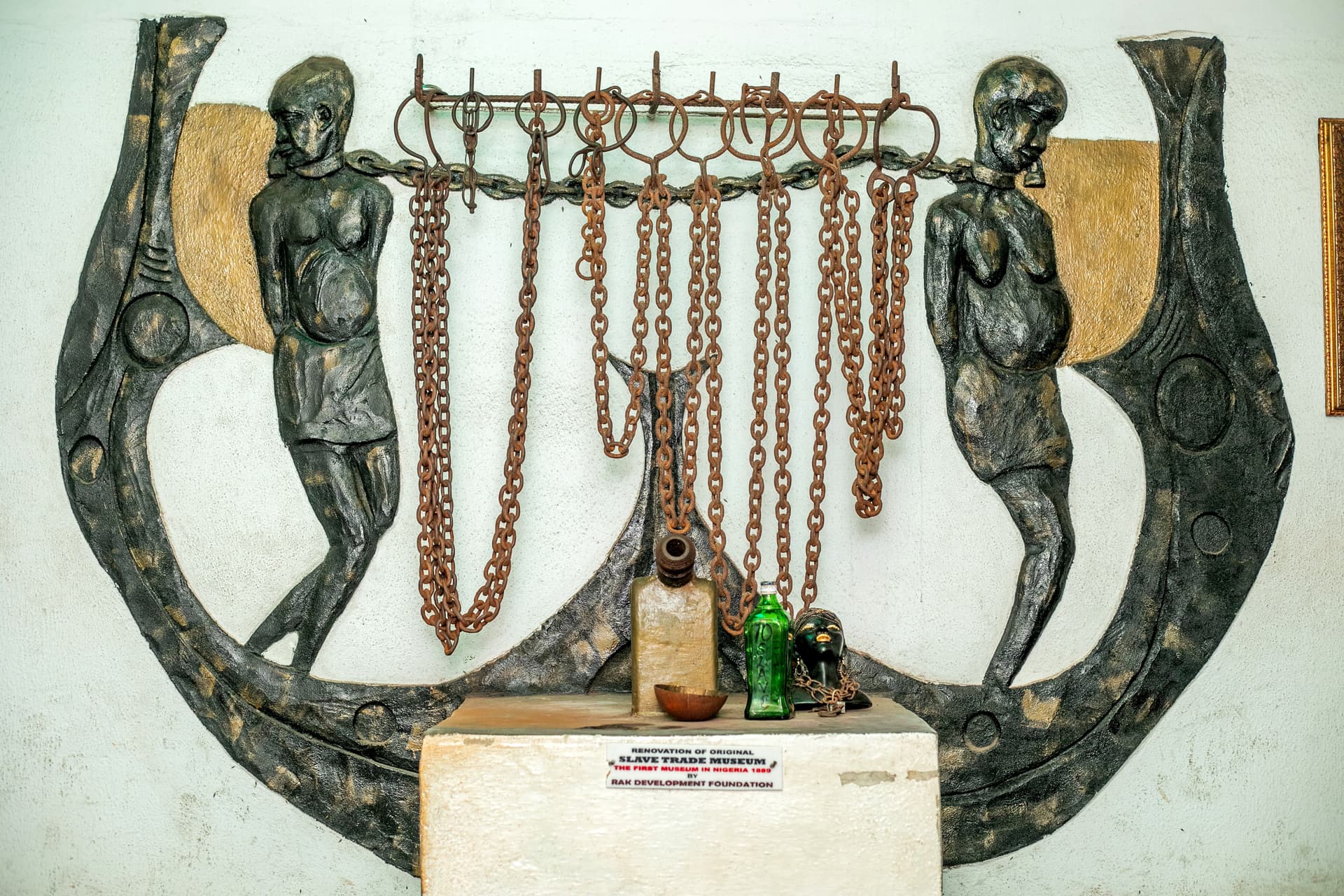
Badagry served as a major outpost during the Transatlantic Slave Trade, when captives from across the region were held, processed, and shipped from its coastline to the Americas and Europe over more than three centuries. The town's preserved sites — chains, cells, and original artifacts held by the Mobee Royal Family for generations — chronicle this history with a directness that's rare: this isn't a reconstruction or a museum built around secondhand accounts, it's the actual location, with objects and records passed down within the same families connected to that era.
The Point of No Return
The Point of No Return, on Gberefu Island, is the specific spot where captives took their last steps on African soil before being loaded onto ships. It's reachable only by boat — a roughly five-minute crossing costing $1 to $3 per person depending on group size — and standing there, after walking the route that led captives to it, is the part of a Badagry visit most travelers describe as staying with them longest. It's not a dramatic monument built for spectacle; it's a quiet, marked stretch of coastline, and that plainness is part of what makes it land as hard as it does.
The museums
The Mobee Royal Family Museum holds original chains, shackles, photographs, and records from the slave trade era, preserved by a family with direct historical ties to the period — a genuinely rare kind of primary-source access. The Badagry Heritage Museum provides broader historical and cultural context for the town's role in the slave trade and its Yoruba and Egun heritage more generally, giving structure to what you see at the more specific, singular sites.
The First Storey Building
Built in 1845 by Christian missionaries, the First Storey Building in Nigeria is exactly what its name says — the first two-story building constructed in the country, and a landmark tied to the missionary period that followed the slave trade era in Badagry's history. It's a shorter stop than the slave route sites, but it adds a layer to the town's broader 19th-century history beyond the trade itself.
What a Badagry heritage tour actually involves
A typical guided visit combines a walk through the preserved slave cells and route, the boat crossing to the Point of No Return, and stops at the Mobee and Badagry Heritage museums — usually structured as a half-day trip from Lagos, extendable to a full day if you add the First Storey Building and time to properly sit with each site rather than rushing between them. A knowledgeable local guide meaningfully changes this visit: much of the context — which artifacts are original, what specific events happened at which point along the route — isn't signposted on-site in the way you'd expect at a Western museum, and is instead carried by the people who guide there.
What does a sample half-day in Badagry look like?
A guided visit is easiest to follow in the order below. Timings vary with traffic, tides and how long your group wants to spend at each site, so treat this as a framework, not a fixed schedule.
| Order | Stop | What to expect |
|---|---|---|
| 1 | Drive from Lagos | Roughly an hour, longer in heavy traffic; start early |
| 2 | Slave route and cells | A guided walk through the preserved sites and the route captives were led along |
| 3 | Mobee Royal Family Museum | Original chains, shackles and records preserved by the family |
| 4 | Badagry Heritage Museum | Broader context on the town and its Yoruba and Egun heritage |
| 5 | Boat to Gberefu Island | A short crossing to the Point of No Return |
| 6 | First Storey Building | The 1845 missionary-era landmark, if you have time |
Allow a full day if you want to linger at the Point of No Return and have lunch in town rather than rushing back through Lagos traffic.
What should you wear and bring?
Dress modestly and comfortably: breathable clothing, closed shoes you can walk in, a hat and sun protection. The crossing to Gberefu Island is by small boat, so bring a light layer, water and a waterproof bag for your phone. Carry small cash for museum entry, boat fares and tips.
Confirm current entry fees and boat prices with your guide, as they change. Ask permission before photographing people, and let your guide advise on what is appropriate to photograph at each site.
Getting to Badagry from Lagos
Badagry is roughly an hour from central Lagos by road, making it a genuinely feasible half-day or full-day trip without requiring an overnight stay — similar in structure to an Abeokuta day trip, though the content and tone of the visit are entirely different. Given both the distance and the emotional weight of the sites, a guided visit removes friction that matters more here than at a typical sightseeing stop: knowing where to go, how to time the boat crossing, and how to move through the history with appropriate context rather than as a checklist.
Visiting respectfully
This is heritage tourism at a genuine atrocity site, not a standard attraction, and it's worth approaching that way — allow real time at the Point of No Return rather than treating it as a quick photo stop, follow your guide's lead on what's appropriate to photograph, and go in prepared for the visit to be heavier than a typical day-trip stop. Most travelers describe it as one of the most important things they did in Nigeria, precisely because it doesn't soften the history.
How Badagry compares to Ghana's Cape Coast and Elmina
Ghana's Cape Coast Castle and Elmina Castle are the region's other major slave-trade heritage sites, and both are larger, more formally preserved fortress structures with an established international heritage-tourism infrastructure built up over decades, including UNESCO World Heritage status. Badagry's sites are smaller in scale and less internationally publicized, but that comes with a trade-off worth understanding: the experience feels more direct and less mediated by a large-scale visitor infrastructure, and the Mobee Royal Family's continued stewardship of original artifacts gives Badagry a specific, personal connection to the history that a larger institutional museum doesn't always convey in the same way. Neither site makes the other unnecessary — travelers doing a combined Nigeria-Ghana trip often find real value in visiting both, since they tell related but distinct parts of the same larger history. See our Top 10 Things to Do in Ghana guide for the Cape Coast and Elmina side of that comparison.
Can you combine Badagry with Ouidah in Benin?
Yes, and it makes a powerful pairing. Ouidah in Benin is another major slave-trade port with its own Route of Slaves and Door of No Return, and the two towns sit along the same coast a short distance apart. Together they tell different parts of the same story.
Crossing the Nigeria-Benin border adds paperwork and time, so this is best done as part of a guided multi-country route. See our 8-day Voodoo Festival tour and best places to visit in West Africa.
Why this matters for diaspora travelers
For the estimated 15 million-strong Nigerian diaspora, and for African-American and wider Black diaspora travelers on a "roots tourism" trip, Badagry offers one of the most direct, tangible connections to this specific history available in West Africa — a real place, not a symbolic one, with a specific, documented route from capture to departure. It pairs meaningfully with a wider Nigeria trip that includes cultural sites like Abeokuta or Osun-Osogbo, giving a fuller picture of the region beyond the trade's history alone. See our Complete Nigeria Travel Guide 2026 for how to structure a trip that includes both.
Frequently asked questions
What is the Point of No Return in Badagry?
The specific site on Gberefu Island where captives took their last steps on African soil before being forced onto ships during the Transatlantic Slave Trade. It's reachable only by a short boat crossing from Badagry.
How do you get to the Point of No Return?
By boat only — a roughly five-minute crossing from Badagry, typically costing $1 to $3 per person depending on group size.
How far is Badagry from Lagos?
Roughly one hour by road from central Lagos, making it a feasible half-day or full-day trip without needing to stay overnight.
What can you see on a Badagry heritage tour?
The preserved slave cells and route, the Point of No Return on Gberefu Island, the Mobee Royal Family Museum (original chains and artifacts), the Badagry Heritage Museum, and the First Storey Building in Nigeria (built 1845).
Is Badagry worth visiting?
Yes — for diaspora travelers and anyone interested in a direct, unflinching connection to Transatlantic Slave Trade history, it's one of the most significant heritage sites in West Africa, not a secondary stop.
How long does a Badagry heritage tour take?
A half-day covers the main sites if you leave Lagos early, and a full day lets you spend longer at the Point of No Return and the museums without rushing. Heavy Lagos traffic is the main variable, so plan around it.
Is Badagry suitable for children?
It can be, but this is a heritage site tied to a painful history, so it is best for older children who can engage with the context. Prepare younger visitors beforehand and let your guide adjust the pace and content.
Should I visit Badagry with a guide?
Strongly recommended — much of the historical context isn't signposted on-site, and a knowledgeable local guide changes the visit from a walk past old buildings into an understood, connected history.

