The short version
Benin travel guide for 2026: visa costs, safety by region, best time to visit and the core draws, Ouidah, Abomey, Ganvié and the Voodoo Festival.
Is Benin worth visiting, and is it safe?
Yes to both, with specifics that matter. Benin is small enough to see in under two weeks but dense with history: the birthplace of Vodun, the seat of the Dahomey Kingdom and home to Ganvié, one of West Africa's most distinctive settlements.
On safety, the coastal south, including Cotonou, Ouidah, Abomey and Ganvié (everywhere our tours operate), is broadly safe for prepared visitors, while border areas near Burkina Faso, Niger and parts of Nigeria carry real, elevated risk per US and other government advisories. This guide covers what to see, what it costs to get in and how to plan around the parts of the country that matter on a first visit.
What are Benin's visa requirements?
Most visitors — including from the US, UK, EU, and Australia — need a visa for Benin, and the e-visa is the standard route for tourism. As of current published rates: €50 for a 30-day single-entry visa, €75 for a 30-day multiple-entry visa, and €100 for a 90-day multiple-entry visa. Apply at least 7 days before travel (and no more than 90 days in advance). You'll also need a valid yellow fever vaccination certificate to enter — this is a hard requirement checked on arrival, not optional.
| Visa Type | Duration | Entry | Cost |
|---|---|---|---|
| Single-entry e-visa | 30 days | Single | €50 |
| Multiple-entry e-visa | 30 days | Multiple | €75 |
| Multiple-entry e-visa | 90 days | Multiple | €100 |
How safe is each region of Benin?
Government advisories are consistent on the shape of the risk: most coastal and southern Benin is safe, including Cotonou, Ouidah, Abomey, and Ganvié — the areas that cover essentially every standard tourist itinerary. The elevated-risk areas are specific and geographically distant from those sites: border regions near Burkina Faso and Niger to the north, and areas along the Nigerian border in Kebbi, Niger, and Kwara states, where kidnapping-for-ransom risk has been documented and where consular services may be limited. Coastal waters also carry their own separate, unrelated hazard — strong riptides and currents make open swimming genuinely dangerous in places, worth knowing if a beach stop is on your itinerary.
The practical takeaway: a standard Benin cultural itinerary — the kind covering Ouidah, Abomey, Ganvié, and Cotonou — doesn't go near the areas advisories flag, the same pattern seen in Nigeria's and Togo's safety profiles. Check current advisories for your nationality before booking, since regional risk assessments are updated periodically.
When is the best time to visit Benin?
December through April is Benin's dry season and the most comfortable window for travel — cooler, less humid, and better suited to the walking involved at Ouidah and Abomey. January is the standout month, not just for weather but for the calendar: the National Voodoo Festival falls on the second Friday of January in Ouidah (8 January in 2027), Benin's most significant cultural event and a genuinely unique experience unavailable anywhere else in the world. The rainy season (April–October) is greener and quieter but less ideal for a first visit, with outdoor sites more difficult to navigate comfortably.
Ouidah: Voodoo heritage and slave-trade history
Ouidah carries two of Benin's most significant historical threads. The Route des Esclaves (Slave Route) traces roughly four kilometers from the town center to the Door of No Return on the coast, the point where captives left the continent during the transatlantic slave trade — walked today largely in silence by most visitors, lined with memorials along the way. The Kpasse Sacred Forest and Python Temple cover the other thread: Ouidah is also one of Vodun's most significant centers, and the Python Temple — where live pythons are kept as sacred, protective animals — sits directly across from Ouidah's Catholic basilica, a physical illustration of the religious layering that defines much of coastal Benin. Kpasse Sacred Forest, a short walk from the temple, is dotted with bronze statues representing Vodun deities among genuinely old trees, some reportedly linked to the town's founding legend.
Ouidah rewards a full day rather than a rushed half-day stop — the Route des Esclaves alone takes an hour or more to walk properly, and rushing past the memorials along it undercuts the point of walking it at all.
Abomey: the Royal Palaces
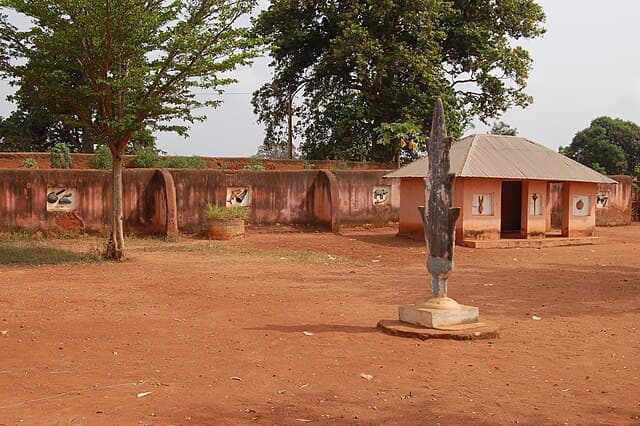
The Royal Palaces of Abomey, a UNESCO World Heritage Site, were the seat of the Dahomey Kingdom — the same kingdom whose slave-raiding campaigns pushed the Tofinu people onto Lake Nokoué, where Ganvié still stands today. Twelve kings ruled from these earthen-walled palace compounds between the 17th and late 19th centuries, and the site today includes a museum housing royal artifacts, bas-reliefs depicting Dahomey military history, and the palace grounds themselves. It's a genuinely significant site — one of the clearest physical records of a major West African kingdom's power and eventual fall to French colonial forces in the 1890s.
Ganvié: the floating village
Ganvié is Benin's single most photographed destination — a village of an estimated 20,000–30,000 people built entirely on stilts over Lake Nokoué, founded by the Tofinu people fleeing Dahomey's slave raids. We cover it in full depth in two dedicated pieces: a complete practical guide (history, logistics, current pricing) and a narrative account of a day there — both worth reading before you go, since Ganvié rewards a visitor who understands its history before arriving, not just its visuals.
Cotonou
Benin's economic capital (Porto-Novo is the official capital, but Cotonou is where most travel actually centers) is home to Dantokpa Market, one of West Africa's largest open-air markets — a genuine sensory experience of textiles, produce, and goods spread across a sprawling riverside site. Cotonou functions mainly as a transit and logistics hub for most itineraries — the airport, a night or two of accommodation, and a jumping-off point for Ouidah, Abomey, and Ganvié — rather than a multi-day destination in its own right, though Dantokpa alone is worth a half-day for anyone interested in West African textiles and market culture.
Porto-Novo itself, the official capital about an hour from Cotonou, is worth a mention for travelers with extra time: it has a distinct colonial-era architectural character, a Brazilian-influenced quarter reflecting the return of freed Afro-Brazilian slaves in the 19th century, and the Musée Ethnographique — a quieter, less-visited alternative to Cotonou's bustle.
Festivals
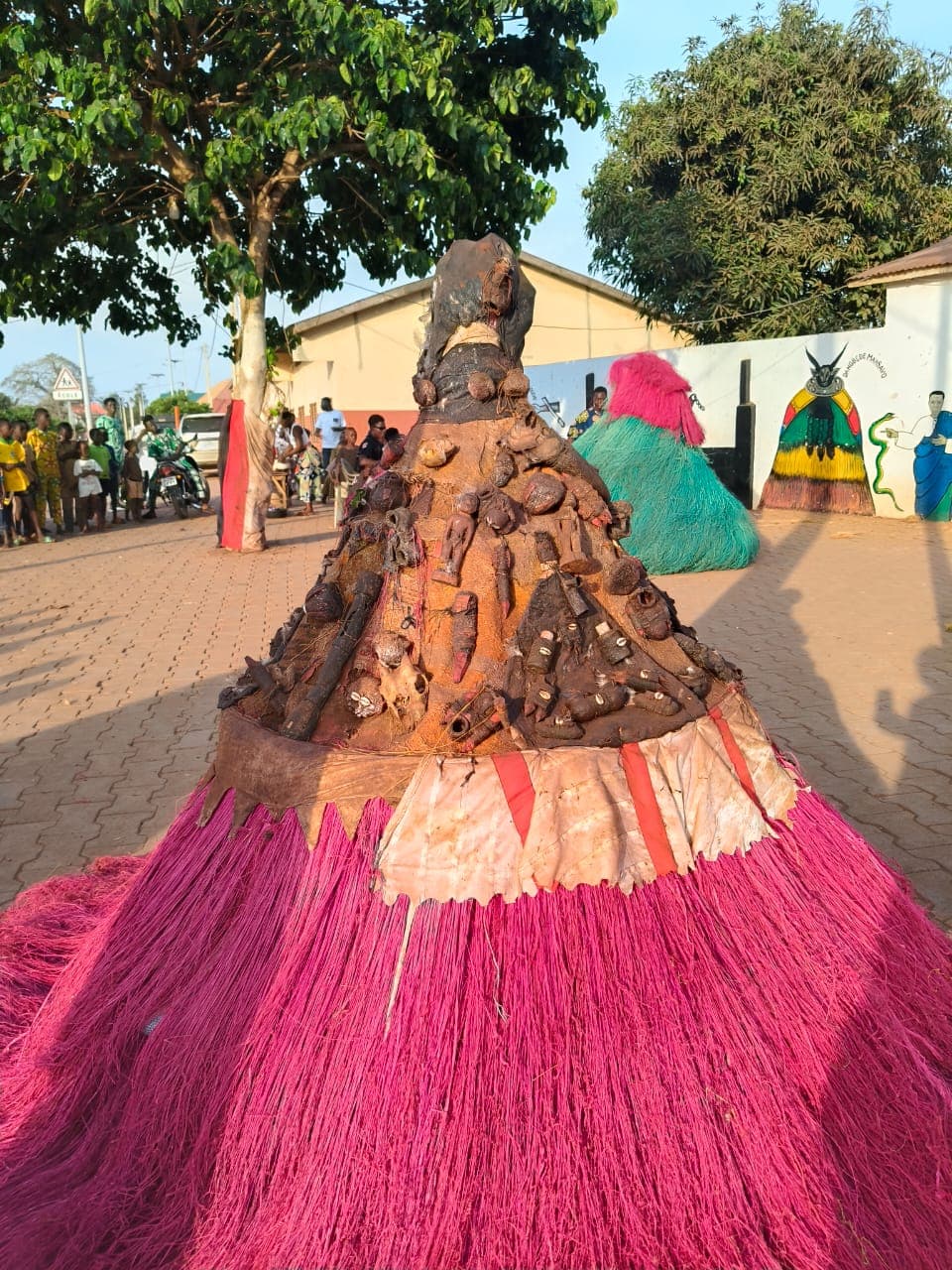
- National Voodoo Festival (second Friday of January, Ouidah) — Benin's most significant cultural event, drawing Vodun practitioners and spectators for trance dances, ceremonies, and public rituals.
- Gelede Festival — a Yoruba-influenced masquerade tradition celebrating mothers and women's spiritual power, observed in parts of Benin's south.
- Egungun Festival — masquerade ceremonies honoring ancestors, observed across the Yoruba-influenced regions of southern Benin.
Food and language
French is Benin's official language, alongside Fon and Yoruba, widely spoken in the south. English is limited outside tourist-facing hotels and guides, which is a genuine reason a guided visit smooths over more friction here than in English-speaking Ghana or Nigeria.
Beninese food centers on pâte (a cornmeal staple similar to Ghanaian fufu) served with a variety of sauces, akassa (fermented corn dough, often paired with grilled fish), and grilled fish and chicken widely available at roadside spots. Cotonou and the larger towns also have a genuine café culture reflecting French colonial influence — worth seeking out for a change of pace between heavier travel days.
How do you get around Benin?
Shared taxis and zemidjans (moto-taxis) handle most short trips within cities, while intercity travel between Cotonou, Ouidah, and Abomey typically runs by shared taxi, private driver, or as part of a guided tour. Distances are genuinely manageable — Ouidah is roughly 40 minutes from Cotonou, Abomey around 2–2.5 hours — which is part of why Benin works well as a compact, dense itinerary rather than requiring long transit days between highlights.
How many days do you need in Benin?
Five to eight days covers Benin's core route thoroughly: 1–2 days in Cotonou/transit, 2 days in Ouidah, a day for Ganvié, and 1–2 days in Abomey, with buffer for travel between them. Benin also combines naturally with Togo — geographically adjacent, with Lomé's Akodessewa Fetish Market extending the same Vodun-heritage thread — which is why most of our itineraries cover both countries in a single trip rather than treating Benin as a standalone destination.
What should you read next?
Plan your Benin trip around the Voodoo Festival
Our 8-Day Voodoo Festival Tour covers Ouidah, Abomey, and Ganvié alongside Togo's Lomé and Kpalimé in one continuous itinerary, timed around the National Voodoo Festival when relevant. Get a custom quote for a Benin-focused or combined Benin–Togo trip.
---
Frequently asked questions
Is Benin safe to visit?
Yes, in the coastal south where standard itineraries operate — Cotonou, Ouidah, Abomey, Ganvié. Elevated-risk areas are specific and geographically distant: northern border regions near Burkina Faso and Niger, and parts of the Nigerian border. Check current advisories for your nationality before traveling.
Do I need a visa for Benin?
Yes, for most nationalities. A 30-day single-entry e-visa costs approximately €50, with multiple-entry options up to €100 for 90 days. You'll also need a valid yellow fever vaccination certificate.
What is Benin known for?
Being the birthplace of Vodun as a formally recognized religion, the Dahomey Kingdom's Royal Palaces of Abomey (UNESCO-listed), Ganvié's floating village, and Ouidah's dual significance as both a major slave-trade departure point and a center of Vodun practice.
How many days do I need in Benin?
Five to eight days covers the core route (Cotonou, Ouidah, Abomey, Ganvié) thoroughly. Many travelers combine it with Togo for a longer multi-country trip given their geographic proximity.
What's the best time to visit Benin?
December through April, the dry season. January is particularly significant if the National Voodoo Festival (second Friday of January, Ouidah) is a priority. The date is set by law each year, so confirm it before you book flights.
Can I drink the tap water in Benin?
Bottled or filtered water is the standard recommendation for visitors throughout Benin, widely available in cities and at accommodation.
What language do people speak in Benin?
French is the official language, alongside Fon, Yoruba, and other local languages. English is limited outside tourist-facing hotels and guides, which is one reason a guided visit reduces friction here more than in Ghana or Nigeria.
Does Benin combine well with other countries on one trip?
Yes — Togo especially, given its direct geographic proximity and shared Vodun heritage (Lomé's Akodessewa Fetish Market extends the same religious thread as Ouidah). Many multi-country West Africa itineraries route through both.